
Introduction
In today’s highly fluctuating market, making any decisions for your business without understanding its value may lead to many consequences such as financial losses, miss market opportunities, growth, new opportunities, and more. Business success is not just dependent on one factor; it includes lots of things such as making smart decisions, understanding the demand and supply ratio, and building relationships. Whether you have a micro business, small-scale business, or an e-commerce giant, data is a pivotal part. By analyzing competitors’ website data, you can take your organization to the next level.
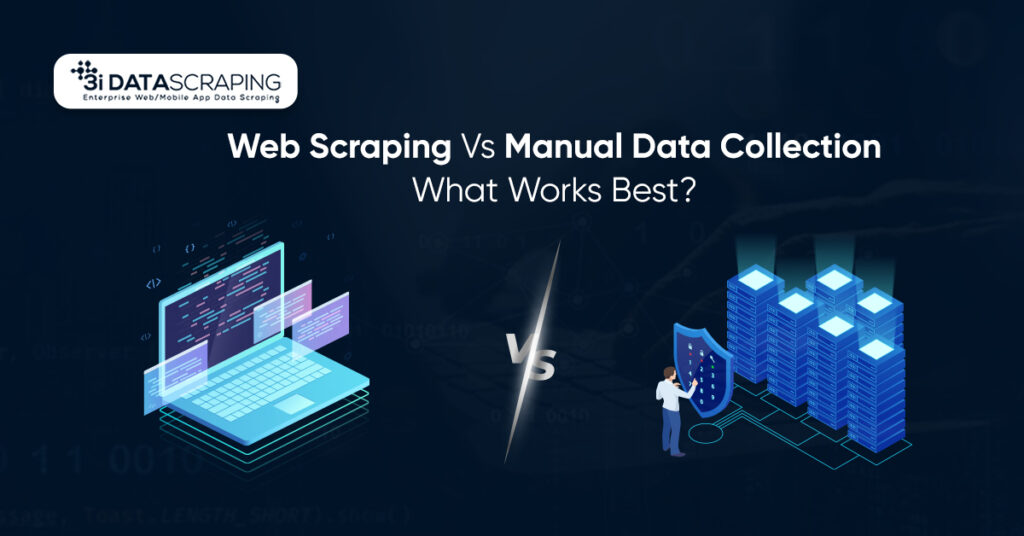
Do you know the internet is full of useful data, and that can lead to better business results? Data is everything; without fully leveraging it, your business may have to struggle a lot in the near future. So now, the question is how to get the full benefits of data in your organization? Well, the answer is either by collecting data from competitors’ websites manually or using automation tools. In today’s blog post, these two methods are key players. Therefore, we will compare them and know which one is better for any organization.
What is Web Scraping
Web scraping can be defined as an automated tool that can visit website pages and extract publicly available data. It’s generally a bot or crawler that can be used to pull out content, images, videos, and more. A web scraper is one of the robust tools to convert HTML data into a more structured format.
Web scraper, an automated tool, can be used for websites, online databases & directories, e-commerce platforms, news & media sites, social media & forums, and so forth to get valuable insights. These valuable insights help your businesses improve their business process, refine inventory, enhance customer satisfaction, and increase revenue.
What Is Manual Data Collection?
Manual data collection is a traditional way that requires human involvement in visiting each and every page of a website and copying the needed content, and pasting it into your spreadsheets or data warehouse, database, data mart, and document store. Because website data is messy and in an unstructured format, you have to clean it up and structure it for the analysis.
What does a Web Scraper Do?
Most of the written content you will encounter on a website is stored in a text-based HTML format. This file has general rules that all websites need to follow. Such rules help to make processing and rendering easier.
Whenever you visit any web page, you will be able to see the output of the HTML code written behind it. However, Robots like Google’s indexing crawlers look at this code only. It is like viewing the same information, but in different forms.
If you want to copy webpage content, then first you need to select it. Once it is done, you have to copy and paste it into a specific file. This is fine if you are following this procedure 2-3 times, but what if you have to do it 100 times? Here, let’s say you have to even sort all this data. Then this will become a grueling task.
Some websites use JavaScript and CSS to even prevent copying content from their website. In this situation, you can use web scraping. It visits web pages and collects HTML code. There are two major differences between a web scraper and manual copy-pasting. The crawler will perform all the tasks for you very quickly.
Difference Between Web Scraping and Manual Data Collection
Criteria | Web Scraping | Manual Data Collection |
Meaning | Visiting website pages and extracting publicly available data. | Copying and pasting website data manually. |
Speed | It is fast and helps to collect a large amount of data in no time. | Slow data collection time depends on the individual’s capacity. |
Accuracy | High | May contain human error. |
Scalability | Highly scalable | Not scalable |
Tools Required | Requires an in-depth understanding of programming languages. | No tolls or technical knowledge required except browser and Spreadsheet tools. |
Cost | The setup cost is high; however, it will be low over time. | The initial cost is low, but the future high labor costs. |
Maintenance | Web scraping tools need updating when using website structure changes. | No maintenance required for the structure. |
Data Volume | The capability to extract a vast amount of data. | Can collect limited data. |
Legal Concerns | Subject to legal constraints. | Fewer legal issues. |
Advantages and Disadvantages of Web Scraping
Advantages | Disadvantages |
Web scraping enables you to automate the data collection process. And thus save your effort and time. | Many websites prohibit collecting information from the website. Going beyond their terms and conditions may block you. |
You can collect a large volume of data from multiple websites. This data is ideal for market analysis and research. | Websites implement techniques that prevent someone from scraping their valuable data. Thus, it creates hurdles in scraping desired data.
|
Extracted web data can be directly fed into a spreadsheet, which helps you to integrate data into machine learning models and a dashboard. | Developing your own scraper requires great knowledge of programming languages. |
Web scraping is effective in reducing labour costs and operational overhead, and helps you save your time and money.
| Website Data depends on HTML structure, which varies across websites. Here, developing a common scraper is not possible.
|
Scraping any website will provide you real-time information to deal with dynamic data that can be used to make a definite pricing strategy to boost your sales.
| After creating a scraper, developers have to check changes in the website and update the scraper accordingly, which takes lots of time and resources.
|
Web scraping can provide you accurate and formatted data with no mistakes in data entry. | Scraping images, articles, and blogs leads to a breach of intellectual property rights, so it requires prior permission from the website administrators to extract them. |
Collected data can be used for developing recommendation systems and training AI systems. | Scraping large-scale data from a website with high frequency can increase load on the server, as it consumes bandwidth and resources. |
Advantages and Disadvantages of Manual Data Collection
Advantages | Disadvantages |
Manual data collection is preferable when you have a small project, because you cannot prove that automated data scraping is worth it. | If you have to collect thousands or millions of data points, then a manual data collection approach can be error-prone.
|
Manual data collection allows researchers conducting interviews to collect data on questions to get deeper responses.
| Collecting a large amount of data without using any tool is beyond human intellect.
|
A Manual data collection approach is ideal if you have to work with handwritten notes and manuscripts. It requires human effort to interpret. | If the data set is large, you have to work hard to gather and manage it. This is not preferable for businesses where time is the centerpiece.
|
Manual data collection can be used to get richer insights. This can be used where subjective interpretation is needed. | Because the manual data is entered or collected before analysis, it cannot be used for industries where timely responses are needed. |
It provides data based on an individual’s ability to visualize and think. This ability cannot replace automated data scraping tools. | Manual data always depends on the individual’s interpretation of information. This dependency affects the overall analysis. |
Tips For Choosing Web Scraping or Manual Data Collection
Web Scraping
- Web scraping can be used when you have to collect thousands of data points.
- When time and consistency are pivotal.
- Choose web scraping when you have to deal with repetitive tasks.
- Use a scraper when you have technical knowledge.
- When there is a need to collect data in a spreadsheet or in a CSV file.
- Use automated scraping tools when you want real-time data.
- Choose scraping tools when there is a need to monitor competitors’ inventory and prices.
Manual Data Collection
- Manual data collection is used when time is not constrained.
- When you have to deal with a small amount of data.
- Use manual data collection when you don’t have much technical expertise.
- When you need data at once.
- Leverage a manual data collection approach when the site blocks bots.
- Use when human judgment is required, for example, collecting only positive or negative human reviews.
- Utilize this method when the data is in a complex file format, i.e., PDF.
Conclusion
Choosing web scraping or data collection depends on your needs and the type of data you have to collect. If you have to gather data with high accuracy and efficiency, then web scraping will be the perfect solution. When you have no technical knowledge, no time limit, then manual data collection is best. The ideal and smarter approach will be to blend both web scraping and manual data collection strategically.
About the author
Mia Reynolds
Marketing Manager
Mia is a creative Marketing Manager who combines data-driven insights with innovative campaign skills. She excels in brand positioning, digital outreach, and content marketing to boost visibility and audience engagement.